

The Sanctuaire site uses cookies to guarantee you the best possible experience on the site and to meet its statistical and audience measurement needs, for future site improvements. Functional, technical and security cookies cannot be configured, as they are necessary for the site to function properly. To find out more about how we handle your data, please consult our privacy policy.


Hôtel N.D des Anges, which became the parish house after M.Vianney’s death
House purchased in 1824 by the holy Curé d’Ars from the shoemaker Étienne Givre, his sacristan and father of Antoine le petit berger.
Expansion of the house of La Providence, founded by the holy Curé d’Ars, when it became an orphanage

La Providence chaplaincy, home to M. Toccanier, curate and successor to the Curé d’Ars
House of sexton Michel Givre-fils, shoemaker, grocer, bookseller, lodger

Site of Antoine Mandy’s oven, where school was held until 1824.
Site of Antoine Mandy’s farm, mayor until 1831.

Birthplace of Catherine Lassagne, first director of La Providence.
Site of Marie Ricotier’s house, where M. Raymond, auxiliary priest to the Curé d’Ars from 1845 to 1853, lived.
Site of the former cabaret, which became a school hall from 1836 to 1840.

Site of the Town Hall until 1840 and home of tailor Claude Petit.

Small château estate.
Farmers: Antoine Rousset then Louis Pertinand.
Landlady: Catherine Chaffangeon.
Jean-Benoît Cinier’s farm, where Mr. Vianney used to get his potatoes.
Site of the house of Jean-Louis Chaffangeon, the former farrier who once said: “I advise the Good Lord and the Good Lord advises me”.

Town Hall (since 1840), where the boys’ school was originally located
Hôtel St Jean-Baptiste managed by François Pertinand from 1842 to 1859.
Former forge of blacksmith Jean Picard
The cemetery (since 1853), where most of the people who played an important role in the life of the Curé d’Ars are buried.
Forge of wheelwright André Verchère, who stood guard at the presbytery when the Curé d’Ars was hearing strange noises.
Château d’Ars was long owned by the Garnier des Garets family.
They generously accompanied and supported the actions of the saintly Curé until his death.

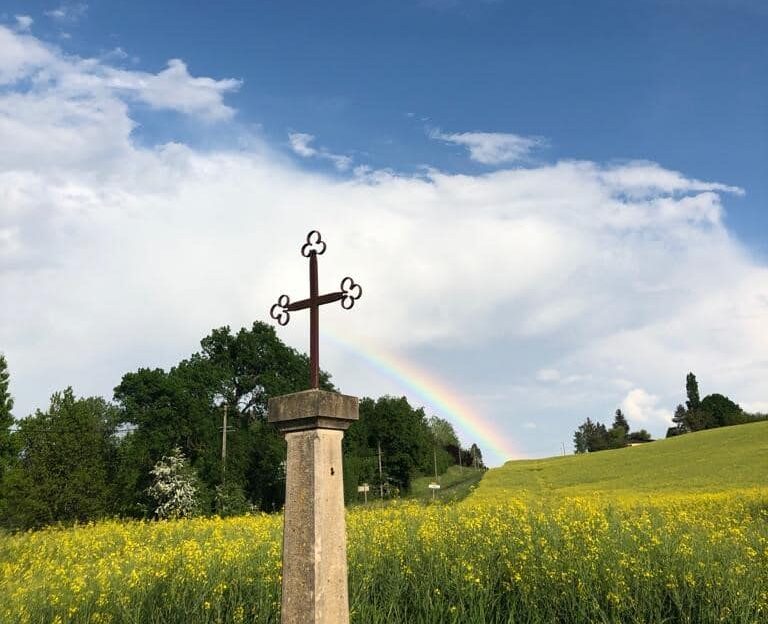
The Monument de la Rencontre commemorates Saint Jean-Marie Vianney’s arrival in Ars and his dialogue with the little shepherd Antoine Givre.


